
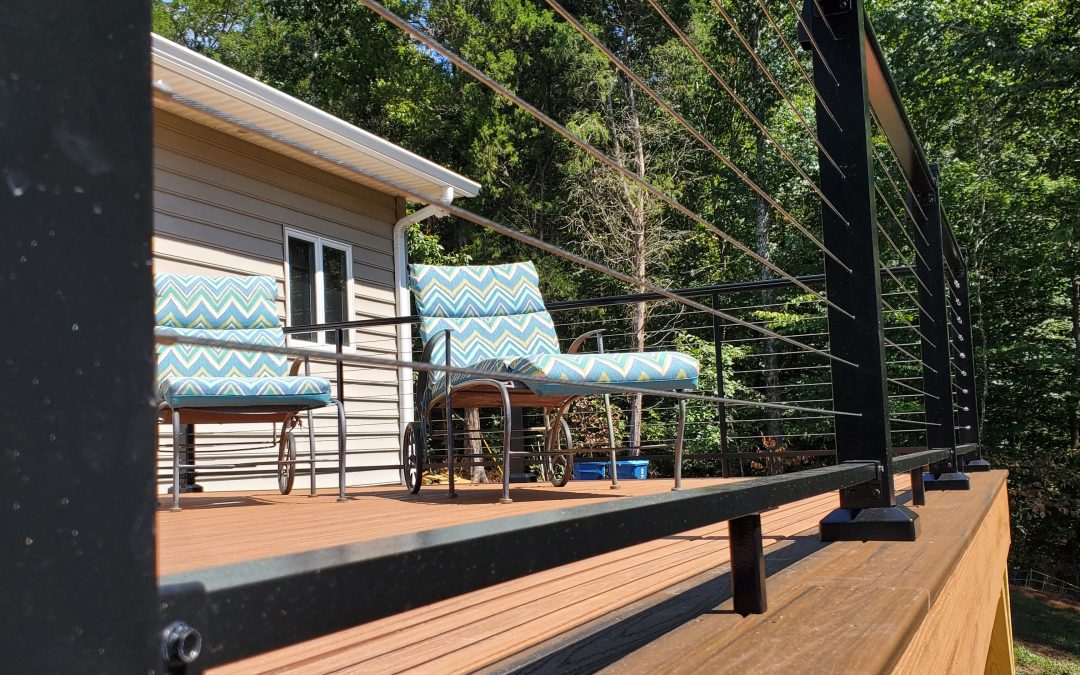
Cable railing systems are often chosen for their modern appearance and unobstructed views, but the true performance of a cable railing system depends on its engineering. Without proper design, spacing, and load management, cable railing can sag, fail inspection, or become unsafe over time.
Madden Industries designs cable railing systems as engineered structural assemblies, not as collections of generic parts. Every component—posts, frames, cables, and tensioning hardware—is selected and engineered to work together to meet building code requirements and long-term performance standards.
This article explains how Madden cable railing systems are engineered, what differentiates them from typical cable rail kits, and why proper engineering matters for safety and compliance.
Why Engineering Matters in Cable Railing Systems
Cable railing introduces unique structural challenges compared to traditional balusters. Tensioned cables create continuous horizontal loads that must be controlled at specific points throughout the railing run.
A properly engineered cable railing system must:
Control deflection under load
Maintain consistent cable spacing
Prevent openings exceeding the 4-inch sphere rule
Withstand long-term tension without loosening or sagging
How madden cable rail …
Madden cable railing systems are engineered to address these challenges through defined post placement, cable support intervals, and tensioning strategies.
Engineered for Code Compliance
To meet residential and commercial building codes, cable spacing must prevent a 4-inch sphere from passing through the railing at any point.
Madden recommends:
3-inch cable spacing for code compliance
Continuous cable support every 3 feet
Structural posts designed to handle cumulative cable tension loads
How madden cable rail …
These guidelines are based on engineering principles and field-tested installations, not assumptions.
Structural Post Engineering: Load vs. Support
Cable railing systems rely heavily on correct post selection and placement. Madden uses two engineered post types, each with a defined role.
Terminal Posts (Load-Bearing)
Terminal posts are the primary load-bearing components in a cable railing system. They anchor and tension the cables and are engineered with thicker wall construction to handle horizontal loads.
Terminal posts are required:
At the start and end of each cable run
At corners and direction changes
Anywhere cables terminate and restart
How madden cable rail …
A single terminal post can support tension from multiple directions, such as at 90-degree corners.
Intermediate Line Posts (Support-Only)
Intermediate posts guide cables between terminal posts and reduce deflection but are not designed to absorb cable tension loads.
Engineering requirements include:
Maximum 6 ft on-center spacing
Placement only between terminal posts
Structural design focused on cable alignment, not tension
How madden cable rail …
Cable Frames and Continuous Support
Between posts, Madden cable railing systems use engineered cable frames to maintain rigidity and spacing.
Each cable frame includes:
Aluminum top cap
Aluminum bottom rail
A centered 1×1 cable support (brace)
The cable support limits cable stretch and ensures no opening exceeds code limits. Engineering standards require that cables be supported at least every 3 feet, whether by a 3×3 post or a 1×1 cable support
How madden cable rail …
.
Frames may span up to 6 feet, providing consistent support without unnecessary visual bulk.
Cable Run Lengths and Direction Changes
Architectural stainless steel cable is significantly stiffer than common hardware-store cable and cannot safely change direction within a run.
Engineering limits include:
Maximum 60 feet per cable run
Runs longer than 60 feet require additional terminal posts
Any change in direction or elevation requires terminating the run and starting a new one
How madden cable rail …
These rules prevent uneven tensioning and long-term system failure.
Stair Cable Railing Engineering
Stair installations introduce angled loads that require specialized hardware.
Each stair cable typically includes:
(2) stair T-angle studs (top and bottom)
(1) stud and stud-style tensioner centered in cable run
Taller terminal posts at stair landings
How madden cable rail …
This configuration allows proper tensioning while maintaining alignment along the stair slope.
Installation Precision and Field Adjustment
Madden recommends drilling posts and cable supports after installation to account for real-world site conditions.
Best practices include:
Using a drilling template
Maintaining cable spacing ≤ 3 inches on center
Repositioning templates for each component
Verifying alignment before final tensioning
How madden cable rail …
This approach ensures both compliance and visual consistency.
Engineered Systems, Not Generic Kits
Madden cable railing systems are supported by:
Professional engineering documentation
Detailed drawings and specifications
Proven residential and commercial installations
Engineering ensures safety, compliance, and durability—whether the project is a residential deck, a commercial stairway, or a long multi-run installation.
📄 Download the Engineering Overview: How Madden Cable Railing Systems Are Engineered
📐 View Cable Railing Systems
🧾 Request a Cable Railing Quote
Recent Comments